In the contemporary digital marketplace, the margin for error in capturing consumer attention is microscopic. Empirical research from Google indicates that users form a definitive judgement regarding a website’s aesthetic appeal in as little as 50 milliseconds.
This visceral “gut feeling” is the primary determinant of whether a user engages with your brand or migrates to a competitor. As we look toward the shifting landscapes of 2026, the strategic deployment of a Visual Branding strategy has evolved from an aesthetic choice into a mission-critical business imperative.
The 50-Millisecond Window: The Criticality of First Impressions-Visual Branding
The initial encounter between a consumer and a brand is overwhelmingly mediated through design.
- Design-Driven Judgments: Data confirms that approximately 94% of all first impressions are design-related.
- Credibility Stakes: 75% of consumers admit to judging a corporation’s professional credibility based solely on its website design.
- The “Ritz-Level” Standard: When a brand fails to deliver a high-end experience—defined by luxury, comfort, and professional execution—it risks immediate trust erosion.
- The Revenue Lift: Conversely, enterprises that prioritize consistent visual presentation across all touchpoints report an average revenue lift of 23% to 33%.
Decoding the Core: Brand Identity vs. Visual Identity
To architect a loyal customer base, one must first distinguish between the “soul” and the “style” of the organization.
Brand Identity: The Organizational Soul
Brand identity constitutes the intangible essence of the business—its mission, core values, voice, and unique story. It represents the internal character that dictates how the brand behaves and communicates.
Visual Identity: The Strategic Style
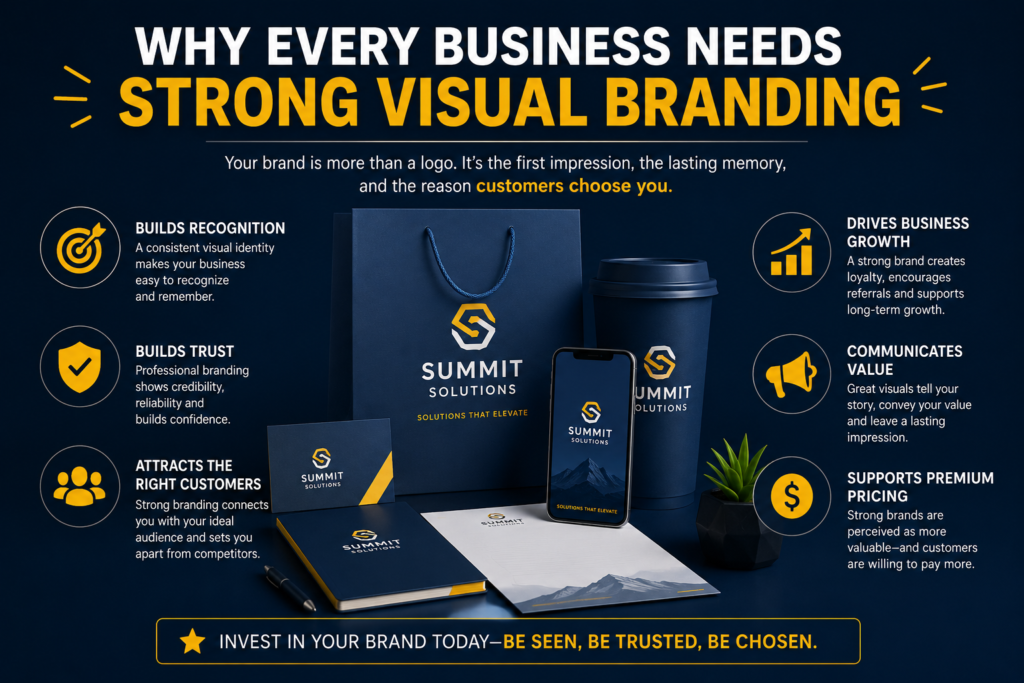
Visual identity is the tangible manifestation of that soul. It encompasses the logo, color palette, typography, and imagery that act as the brand’s face to the world.
The Order of Operations-Visual Branding
Strategic success requires that brand identity be established prior to visual design. A sophisticated logo lacks efficacy if it is not grounded in a clear purpose or mission. At Image Solutions India, we specialize in this foundational alignment, ensuring your visual assets are a precise reflection of your corporate character.
The Cognitive Science of Design: VC, PT, and Hick’s Law-Visual Branding
Superior design is not merely decorative; it is scientifically optimized for human cognition.
Visual Complexity (VC) and Prototypicality (PT)
First impressions are governed by two key variables:
- Low Visual Complexity: Users prefer clean, simple designs that prevent information overload.
- High Prototypicality: Users favor designs that are representative of their category (e.g., using a recognizable shopping cart icon for e-commerce).
Hick’s Law and Decision Fatigue – Visual Branding
According to Hick’s Law, the time required for a user to make a decision increases logarithmically with the number and complexity of choices provided. Overburdening a site with too many options causes users to “freeze.” Implementing “invisible design” allows users to move naturally through an experience toward a conversion point without conscious effort.
Chromatic Authority: The Psychology and ROI of Color
Color is the most immediate communication device in a brand’s arsenal, capable of increasing brand recognition by up to 80%.
- Trust and Quality: Blue is globally associated with high quality, competence, and tranquility.
- Excitement and Action: Red conveys urgency, warmth, and excitement, often used to drive immediate action.
- Cultural Intelligence: Strategic color use must account for cultural nuance. For instance, while white signifies bliss in certain Eastern contexts, it can convey mourning in others. Similarly, orange is sacred in India but can be perceived differently in parts of Zambia.
The Strategic Mandate of Visual Consistency- visual branding
Consistency is the pillar upon which recognition is built. Inconsistent branding—characterized by “visual drift” in colors, fonts, or logo usage—signals a lack of attention to detail and erodes consumer confidence.
Building Familiarity and Trust
Familiarity fosters trust. When consumers encounter a consistent visual pattern, they navigate intuitively. Legendary brands like Coca-Cola have maintained visual consistency for over a century, using their Spencerian Script and signature red to remain instantly identifiable worldwide.
Efficiency and Profitability
Consistent brands are more efficient; they require less media spend to achieve the same results as inconsistent competitors. In fact, consistent branding often delivers double the profit gains of fragmented identities.
2026 and Beyond: Future-Proofing Your Brand Identity(Visual Branding)
As we approach 2026, several shifts are defining the next generation of brand loyalty:
- Motion-First Identities: Static visuals are becoming secondary to kinetic logos and dynamic UI behaviors that hold attention in screen-led environments.
- Hand-Crafted Imperfections: In response to the rise of hyper-polished AI imagery, brands are adopting “hand-drawn” nuances and tactile textures to signal human authenticity.
- Accessible Excellence: Accessibility has transitioned from a compliance requirement to a foundational trust signal. Implementing AA contrast standards ensures the brand is usable for all.
Professional Implementation with Image Solutions India
Achieving this level of strategic design requires a partner who understands the deep linkage between visual branding and customer loyalty.
Image Solutions India provides the end-to-end expertise required to transform your brand from a local participant into a global competitor. From developing comprehensive brand playbooks to executing motion-first digital assets, we ensure your visual identity is your most potent growth engine.
FAQ: Expert Solutions with Image Solutions India
1. How can I resolve “visual drift” and ensure consistency across my global digital estate?
Visual drift occurs when manual design reviews fail to keep pace with rapid content publication. Image Solutions India provides specialized brand audit services and the development of “living” design systems. We help you establish automated verification processes to ensure every pixel aligns with your exact color codes and typography standards.
2. How do I adapt my brand for future trends like “Motion-First” and “Humanized AI” design?
By 2026, motion will be as essential as a color palette for holding user attention. Image Solutions India offers advanced motion graphics and kinetic typography services to bring your brand to life. We also specialize in “humanized” design elements—tactile textures and bespoke typography—that differentiate your brand from sterile, AI-generated content.
3. My website has a high bounce rate; how can visual design improve my conversion performance?
High bounce rates are often the result of excessive Visual Complexity or a lack of Prototypicality. Image Solutions India utilizes cognitive design principles, such as Hick’s Law, to simplify your user interface. By optimizing your visual hierarchy and implementing “invisible design” patterns, we can help increase conversion rates significantly.
Leave a Reply