In the contemporary landscape of digital photography, the sky changeis far more than a background element; it is a critical driver of emotional narrative and commercial value. A dull, overcast horizon can diminish the impact of a high-end architectural shoot, while a vibrant, well-composed Sky Change can elevate a property’s marketability instantly. As Artificial Intelligence (AI) continues to redefine the boundaries of post-production, AI sky replacement has transitioned from a niche manual task to a sophisticated, automated workflow capable of delivering surgical precision in seconds.
This guide provides an expert-level exploration of the tools, techniques, and strategic considerations required to master sky replacement, ensuring that every transformation remains authentic, professional Sky Change, and visually striking.
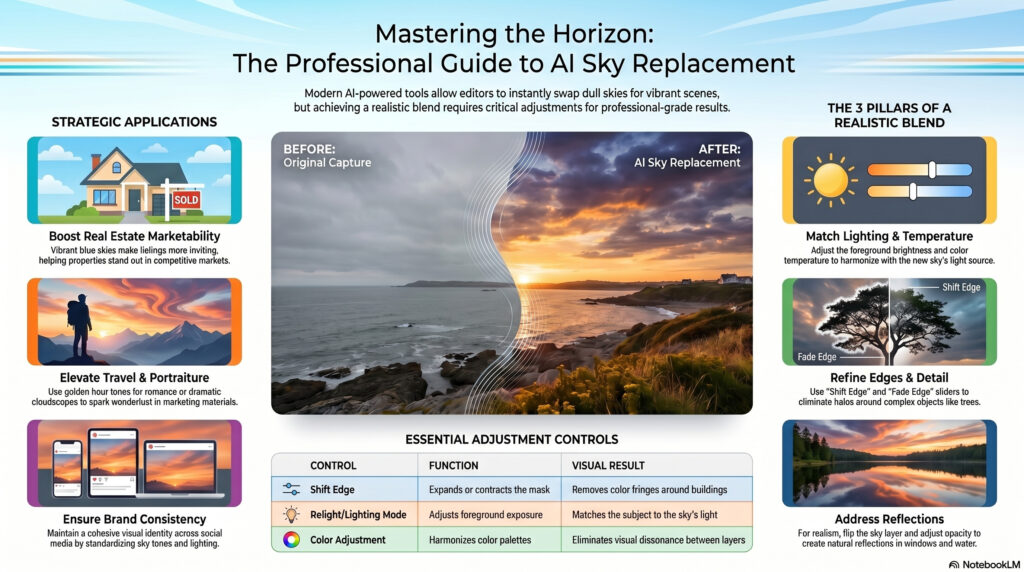
1. The Strategic Importance of the Horizon- Sky Change
The Emotional and Psychological Impact
The sky serves as the primary source of natural light and tone in an outdoor image. By altering the cloudscape, an editor can evoke specific emotional responses:
- Warm, golden hues: Create a “cozy sunset vibe.”
- Dramatic, high-contrast clouds: Produce an intense, editorial aesthetic.
Commercial Imperatives in Real Estate and Travel
In the real estate sector, visual first impressions are paramount. Potential buyers frequently bypass listings with gloomy or “washed-out” skies in favor of those showcasing properties under bright, inviting horizons. Professional sky replacement ensures consistency across a portfolio, regardless of the weather conditions on the day of the shoot. Similarly, in travel marketing, enhanced skies are utilized to spark “wanderlust,“ transforming ordinary nature shots into aspirational marketing assets for websites and social media.
2. Advanced Software Ecosystems for 2026 – Sky Change
Adobe Photoshop: The Industry Benchmark
Photoshop’s Sky Replacement feature, powered by Adobe Sensei AI, remains a cornerstone for professional editors. By choosing Edit > Sky Replacement, users can access a curated gallery of “Blue Skies,” “Spectacular,” and “Sunset” options. The true power of Photoshop lies in its non-destructive nature; every adjustment generates a corresponding Adjustment Layer or Layer Mask, allowing for granular control over the final composite.
Luminar Neo: The Modular Powerhouse
Luminar Neo is increasingly favored for its efficiency and specialized AI tools, such as Atmosphere AI (for fog and mist) and Relight AI. Its modular engine is designed to handle high-resolution raw files without performance degradation. For many professionals, Luminar Neo serves as a powerful Lightroom plugin, allowing them to “step out” for specialized sky edits before returning to their primary catalog.
Pixlr and Mobile Solutions
For rapid web-based edits, Pixlr offers an intuitive “Sky Changer” that automatically removes backgrounds and allows for text-prompted sky generation via Generative AI. On the mobile front, SkyPic provides one-tap transformations, though professionals must be wary of resolution loss often associated with mobile exports.
3. Technical Troubleshooting: Achieving “Surgical Precision” -Sky Change
The hallmark of an amateur sky swap is the presence of “halos” and “fringes”—bright or unmasked areas around intricate foreground details like tree branches or rooflines. Achieving professional results requires advanced manual intervention.
The Gray Fill Technique for Defringing
Expert editors often employ a 50% Gray fill layer to neutralize contrast issues:
- Create a new layer and set the blending mode to Overlay.
- Fill the layer with 50% Gray.
- Use the Burn tool at approximately 30% exposure to lightly brush around the fringes of the foreground.
This technique effectively darkens the “white” halos, allowing the new sky colors to blend more naturally with fine details.
Advanced Alpha Channel Masking -Sky Change
For maximum precision, particularly with “twiggy sticks” or complex foliage, Alpha Channel masking is the superior method:
- By saving a selection as a new Alpha Channel, you can use Levels adjustments to increase the contrast between the black (masked) and white (unmasked) areas.
- Dragging the white slider to the left reveals hidden details in the mask, allowing you to “brush in” sky color where automatic AI tools might have failed.
4. The Realism Factor: Lighting and Reflections
A seamless sky replacement must account for the physics of light. If the lighting on the foreground does not match the sun’s position in the new sky, the image will appear artificial.
Harmonizing Tones and Shadows- Sky Change
Photoshop’s Foreground Adjustment panel is essential for this process. The Lighting Mode (Multiply to darken, Screen to lighten) allows the editor to match the main background image to the luminosity of the new sky. Additionally, the Color Adjustment slider uses Curves to harmonize the color temperature between the original scene and the new horizon.
Managing Surface Reflections
In professional real estate photography, any sky swap must be reflected in windows, pools, or glass doors.
- Best Practice: Flip the sky layer vertically, reduce its opacity, and use a gradient mask to blend it into the water or glass.
- Refinement: Use the Clone Stamp tool to fix any discrepancies where the reflection meets the edge of the reflective surface.
5. Expanding Horizons: Sky Replacement in Video
Advancements in software have brought sky replacement to video production, though the technical requirements are more stringent.
Luma Keying in Final Cut Pro
In clips with a dark foreground and a light, overcast sky, the Luma Keyer is the most efficient tool. By adjusting the Luma sliders in the Matte view, editors can make the sky completely transparent (black) while keeping the foreground opaque (white).
Tracking and Motion
Static sky swaps in video clips with camera movement will look disconnected. To fix this, use an Object Tracker to analyze the movement of the original footage and apply that tracking data to the new sky background. This ensures the new horizon moves in perfect sync with the camera. In Photoshop, you can “trick” the system by converting a video into a Smart Object, though this is limited to stationary tripod shots.
6. Professional Workflow: Why Outsourcing is the Ultimate Solution
While AI has simplified the process, the “last 10%” of editing—fixing complex halos, matching reflections, and maintaining bulk consistency—remains time-intensive and technically demanding. For high-volume businesses, outsourcing to specialized experts like outsourceimage is the most cost-effective strategy.
Outsourceimage provides high-tier image retouching solutions that eliminate the frustration of manual masking. By delegating these complex tasks to professionals, photographers can focus on their core creative work while ensuring their final deliveries meet the highest industry standards for realism and aesthetic appeal.
7. Asset Management: Curating Your Personal Atmosphere -Sky Change
To stay ahead, professional editors should not rely solely on software presets.
- Create a Custom Library: Take photographs of unique skies during your travels and import them as custom presets.
- Diversify Your Stock: Utilize high-quality, free resources such as Unsplash, which offers over 750 free sky overlays ranging from serene blue days to spectacular storm fronts.
- Consistency: For large projects, use Batch Processing to apply the same sky and lighting adjustments across multiple shots, ensuring a unified brand identity.
8. FAQ’s: Comprehensive Solutions from outsourceimage
As a versatile leader in professional support, outsourceimage provides solutions for customer queries through their diversified service wings. Below are the most frequent inquiries regarding our comprehensive support.
1. How does outsourceimage ensure the quality of high-volume photo edits?
Outsourceimage utilizes a combination of advanced AI-powered tools and manual expert oversight to maintain 100% consistency across thousands of images. This “hybrid” approach ensures that even complex elements like foliage and water reflections are handled with surgical precision.
2. Can outsourceimage handle both residential and commercial real estate projects?
Yes. Our team is trained to recognize the different aesthetic requirements of residential listings (which favor warmth and invitation) and commercial projects (which often require a bold, crisp, and high-contrast editorial look).
3. What is the typical turnaround time for professional sky replacement?
Depending on the volume, most projects are returned within 12 to 24 hours. Our global workforce allows us to leverage time-zone differences to provide overnight results for our clients.
4. Does outsourceimage provide support for video sky replacement and object tracking?
Absolutely. Beyond still imagery, our technicians are skilled in Final Cut Pro and DaVinci Resolve workflows, providing seamless sky swaps for video content, including parallax correction and motion tracking.
5. How can I start a project with outsourceimage?
Simply reach out via our contact portal to schedule a consultation. We offer a trial period for new clients to experience our “surgical precision” firsthand before committing to high-volume contracts.
Conclusion
The evolution of AI has made sky replacement an essential tool in the modern photographer’s kit. By mastering technical nuances—such as Alpha Channel masking and lighting harmonization—and leveraging the expertise of professional partners like outsourceimage, you can ensure that your visual content always stands out in a competitive marketplace. The sky is no longer a limitation; it is your canvas.
Leave a Reply